Cooperation Jackson and SECOSOL
Feb. 4, 2025
Cooperation Jackson and SECOSOL
Feb. 4, 2025
I am currently enrolled in a seminar with Trebor Scholz through the CPE program at the New School titled Eco Radicals: The Legacy of Revolutionary Cooperatives. This is the second of Trebor's seminars in which I've participated, the first one being Platform Cooperatives Now! back in the Summer of 2020. I was introduced to Trebor by my dear friend Micky Metts, one of the countless gifts from Micky for which I will be forever grateful. Trebor is the kind of intellectual activist who embodies The Eleventh Thesis on Feuerbach. There are so many things I learned about in the first seminar that have profoundly impacted my work ever since, and this current seminar promises to be the same.
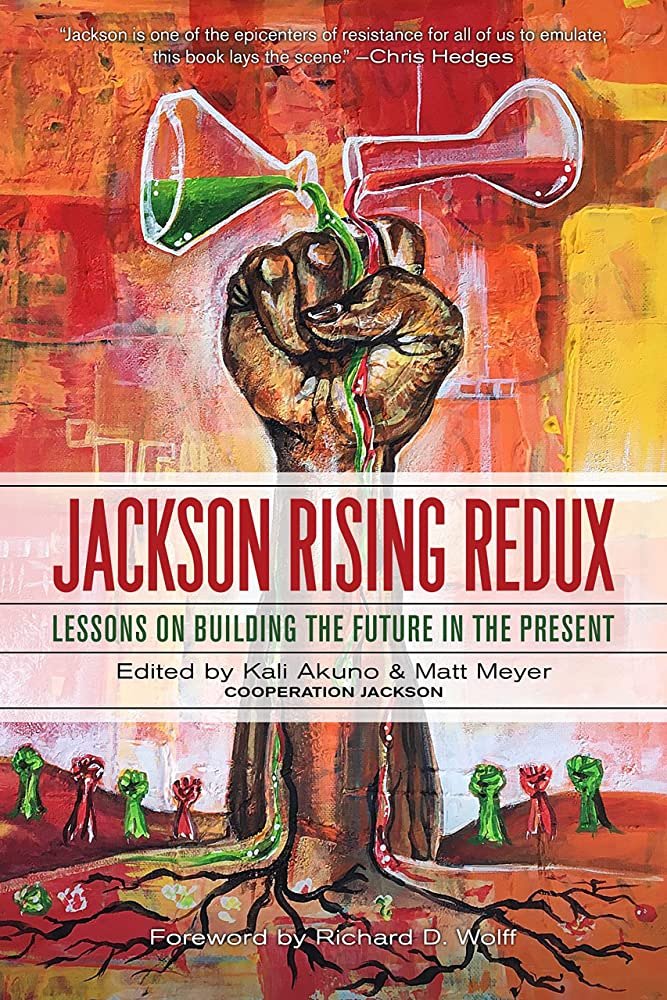
Our first writing assignment was to respond to reading Jackson Rising. This post is my attempt to complete that assignment.
I've already read Jackson Rising twice, several years ago, but it is great to be able to discuss it with comrade classmates from around the world. Our seminar has participants from Bulawayo Zimbabwe, Bangaluru and Kerala India, Montevideo Uruguay, Santiago Chile, New York City, North Carolina, South Korea, and yours truly from Arlington, Virginia. Many of the participants have lots of real world experience with worker cooperatives, so class discussions are rich. I am greatly looking forward to our discussion tomorrow of Jackson Rising. I'm actually reading Jackson Rising Redux, since I have a copy of this updated version and wanted to use this opportunity to read it. I'm a slow reader, and did not come close to taking in the more than 500 pages in this book, but I read all of Build and Fight: The Program and Strategy of Cooperation Jackson, and I poked around in other sections of the book.
As a solidarity economy activist since 2012, what strikes me most about Cooperation Jackson, is that it has a broad, integrated, and well thought out program for social transformation without peer as far as I know in the solidarity economy movement.
Despite the limited capacity, experience, and resources of our organization, we dream big and plan big. There are some, friend and foe alike, who maintain that our program and strategy constitute an extreme case of overreach. There is undoubtedly some truth in this statement, but we make no apologies for our approach. We firmly believe that we must demand the impossible, both of the world and of ourselves, in order to change both subjects (page 25).
The program and strategy of Cooperation Jackson can most broadly be described as plan for ecosocialism, which is described in a paragraph in the book's introduction.
What, you might ask, is “ecosocialism,” and why is Cooperation Jackson aiming to build it? Loosely defined, ecosocialism describes a classless socioeconomic system in which humans live in balance with nature. Exchange value would be subordinated to use value by organizing production primarily to meet social needs and the requirements of environmental protection and ecological regeneration. To build an ecologically rational society along these lines requires the collective ownership of the means of production, democratic planning to enable society to define the goals of production and investment, and a new technological production structure that meshes with society’s plans and stays within the Earth’s ecological carrying capacity (page 1).
In Cooperation Jackson's more than decade long effort to put their theory into practice, they developed four interconnected and interdependent institutions:
- A federation of local cooperatives and mutual aid networks
- A cooperative incubator
- A cooperative school and training center
- A cooperative financial institution
Development of these institutions is being executed under five intentionally interlocked and interdependent focal points to make the city of Jackson, Mississippi a:
- Solidarity city
- Sustainable city
- Fab city
- Worker's city
- Human rights city
The book explores these focal points and discusses Cooperation Jackson's experience building the its institutions. Since I have to finish this post today so it can be shared with my classmates tomorrow, further exploration of Cooperation Jackson will have to wait until another day. The most immediate impact of this reading assignment on my thinking has to do with its relationship with the work we are doing in SECOSOL

SECOSOL itself is working to become a cooperative incubator, a seedbed of the solidarity economy. It's first project has been helping a cleaning cooperative, Mujeres Manos a la Obra, launch itself as a business that can sustain the three worker / owners and contribute to improving their livelihoods and lives.
With an annual budget of a little over \$20 thousand dollars, used primarily to support our 1/2 time staff person, SECOSOL has spent most of its energy and very limited resources helping the coop get started. In that effort it has been successful. The worker / owners of Mujeres Manos a la Obra have been able to leave their previous jobs working for someone else, and they are now earning and learning. We at SECOSOL learned a great deal about what needs to be done to start a business by walking this walk together with the coop members. This past December, both SECOSOL and Mujeres Manos a la Obra celebrated their accomplishments at a VASEN Dinner.
It is now time for SECOSOL to look forward to its next challenge. I know that I share a strong commitment with both our co-presidents to transformational activity well beyond just helping a few small democratic businesses marginally improve the lives of their members while still living under a toxic, unjust, and incredibly dangerous system. We want more, much more! As Kali Akuno says at the end of the introductory essay Build and Fight: The Program and Strategy of Cooperation Jackson, "As our actions in Jackson, Mississippi, over the past decade demonstrate, we can change the world for the better by working together in solidarity." (page 51).
By their own admission, the comrades from Cooperation Jackson are taking a great risk in exposing their program to the world. They did it because they believe deeply in the power of the oppressed to liberate ourselves. They believe that the insight, motivation, and strength we will gain from their example will more than offset the harm that will come from our oppressor's use of this same information against us. Cooperation Jackson is helping lay the path for SECOSOL and other solidarity economy activists to follow. Let's march forward together!
In solidarity,
Jeff Elkner
4 February 2025