Toward a Social Justice Computing School in Liberia
July 1, 2026
Toward a Social Justice Computing School in Liberia
July 1, 2026
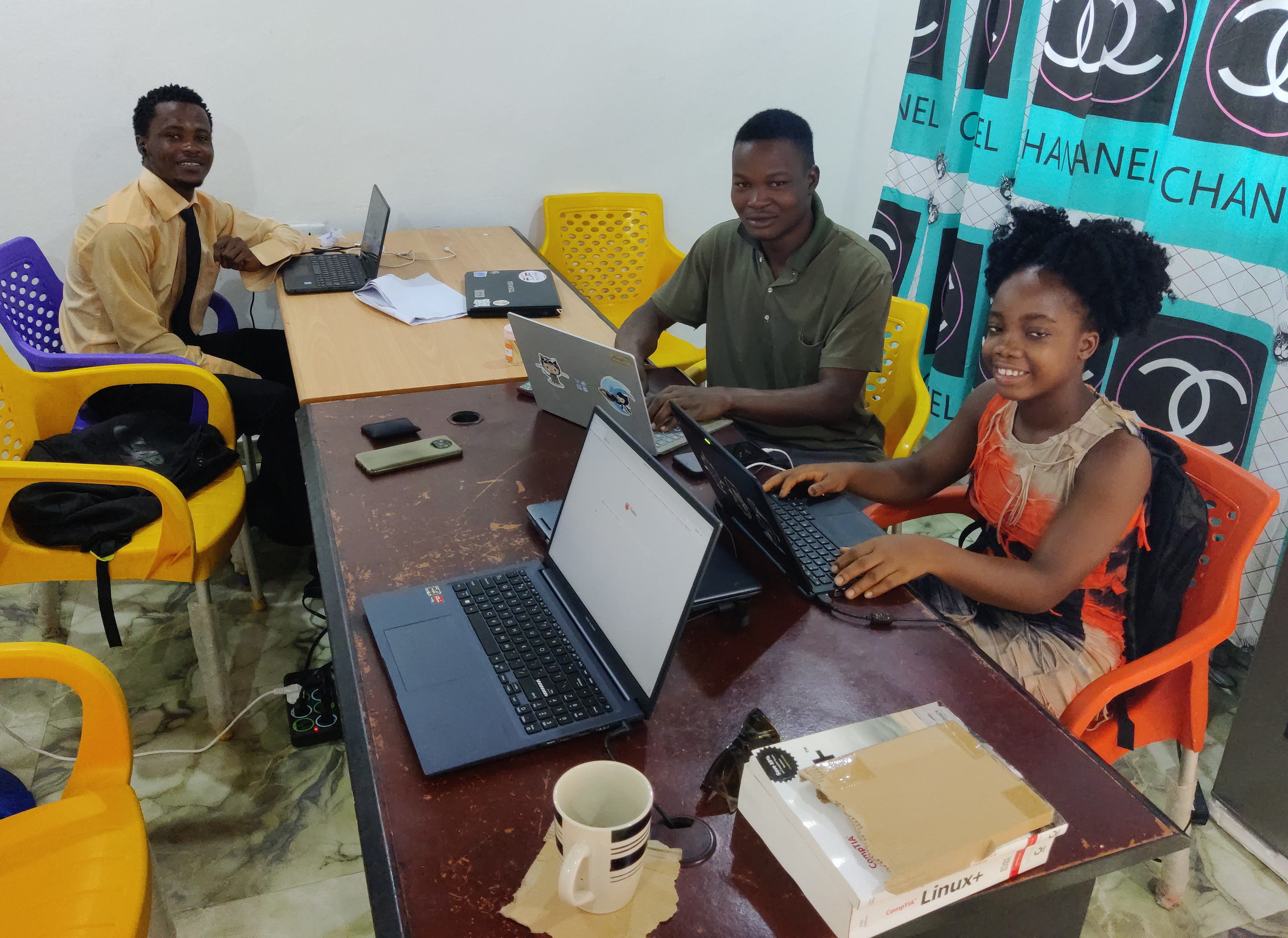
Each morning I've been here so far, I've awakened to Daniel already up and at work doing morning chores or on his computer. As I learned in conversation with him this morning, however, often times it is Freena who is the first one awake at the Jetro office, banging on the door to get Daniel to wake up and let her in. He told me he loves working with Freena and looks forward to seeing her first thing in the morning.
Freena was the first Jetro member not living at the office to arrive today, with Gabriel following only a few minutes behind her. So the Jetro Web "early birds" for this July 1st morning are Daniel, Freena, and Gabriel. During our morning conversation, the topic of our hoped for Social Justice Computer School came up, as it often does, so I figured I should make my blog post today about that.
Background and Context
Rereading each of the posts I made about our educational project here starting with First Days in Liberia, I realize that I did not mention the idea of building an ICT school here, even though the idea has been a central part of our discussion it since that first visit. So this post is long overdue, especially since beginning the planning for it, with a target project launch in two years, is one of our core goals for my visit.
The immediate concrete goal of my first trip to Liberia in 2022 was to help my friend and colleague, Isaac Zawolo, who had recently been appointed superintendent of the Monrovia Consolidated School System (MCSS), to build MCSS's computer science and information technology program. Our thinking from the beginning was that we would use the lessons the two of us had learned as pioneers in the dual enrollment program in Arlington Public Schools to try to implement a similar program within MCSS.
Part of our plan was to build a small, ICT focused "special program" school within MCSS in collaboration with the Kamal Foundation in Washington, D.C., the saloon that builds schools around the world. Having started a web tech worker cooperative, NOVA Web Development, back in 2012 with the goal of providing a social justice oriented pathway into the ICT field for my students, I had the idea that we could do that in our Monrovia project also, and that the school and the cooperative could be built together in partnership. At the end of that first summer teaching, I had six students from the class interested in continuing with our studies as interns with NOVA Web Development (see Mission Accomplished!). I have been working with them ever since, and they now have a web tech co-op of their own, Jetro Web Development.
Then a Liberian presidential election happened, Isaac Zawolo was no longer superintendent, and our plans evaporated. With no land on which to build, and with folks at the Kamal Foundation understandably angry with us for causing them to have to break a commitment with their donors, we were left empty handed.
But the dream refused to die. Instead, it morphed into a new form. Once the doors to collaboration with the Liberian government were closed to us, we began looking instead at finding a community partner that would have land on which to build a school. We worked toward this goal during my second visit here in 2024, meeting with church groups and community organizations. One community group was very excited by the idea, and they thought they had community land available for the project (see Jetro Web Development: Looking Back, Moving Forward). It turned out they didn't. There was vacant land in their community which they had already used to put a small park for children to play sports, but the community did not hold title to the land, and could not authorize a school project there.
We learned a lot from this effort, but by the end of it we found ourselves again back at square one.
Social Justice Computing
Social Justice Computing (SJC) is a non-profit organization registered in the state of Virginia that was formed in March, 2024 by a teacher, yours truly, two students, Ved Chudiwale and Vrishin Hazari, and a public policy analyst, Dr. Stephen Hubbard. Each of the founders had a different motivation for starting it. Ved and Vrishin were aspiring entrepreneurs who wanted the experience of starting a non-profit. Dr. Hubbard was hoping to build a web application to raise awareness in support of his idea for a national infrastructure bank, and I wanted a non-profit organization that could be used to support Jetro Web and the school project in Liberia.
During its first two years, I have been SJC's only donor. We have used the funds to give grants to both Jetro Web and NOVA Web to help launch their businesses. The amounts have been small, averaging around a thousand dollars a month. Since in the early stages of the project Jetro Web members did not yet have marketable skills, the funds were mostly used to support their education and training.
After four years of dedication and hard work, Jetro Web Development is ready to seek paying customers to launch its business, and Social Justice Computing can say that the first phase of its first solidarity economy project has been a demonstrable success.
With the web tech co-op ready to launch, we can start planning for our school.
Vision for a Social Justice Computing School
With our social justice computing school we seek to:
- create an affordable opportunity for either early college students or high school graduates to pursue college level education in web development and computer science utilizing the OER curriculum materials developed by us for Arlington Tech.
- provide work while you study opportunities for students in the program through internships with Jetro Web Development.
- infuse the program with a solidarity economy and social justice orientation so that graduates will hopefully continue on in their careers to support our values of "making a living, not a killing", "helping to build the world we want to live in", and "using the people's software to support the people's movement."
In a nutshell, we want to take the valuable lessons we have learned together over the last four years and build on them more broadly.
A Legal Entity to Own the Land
Our immediate next task at this point is to create a legal entity that can own land on which to build our school. We know it should be some kind of Liberian NGO closely partnered with Social Justice Computing. But how this organization should be structured and what kinds of governance it should have is not at all clear to us.
We need to morph the idea we had at the beginning of some kind of solidarity economy oriented remix of a neoliberal P3 between MCSS and Jetro Web Development into a similar legal and governance arrangement that enables Jetro Web Development to operate its for profit business on land owned by the community non-profit entity, with Jetro in turn providing work experience opportunities for the students at the school.
Or perhaps Jetro should own its own little plot of land adjacent to the school? In either case, in our wildest, long term dreams our little school will become a seedbed of the solidarity economy, helping graduates to launch a series of worker cooperatives doing different kinds of businesses, and expanding our educational program in direct response to the needs and interests of our community.
Expanding Our Horizons
In taking on the creation of a material school building, we will be moving well beyond our current areas of comfort in curriculum development and educational program planning. We will be directly engaging in the social production of space, and we will want our school and worker co-op office space to provide sustainable, solar powered electricity, and clean, running water.
Even thinking about this presupposes we are able to successfully navigate the expansion of our horizons from educational development to successful web tech business launching that we are undertaking right now. Our long term vision requires being able to develop viable democratically run businesses that can enable students who leave our program to make a living. Without that, our project does not make sense.
A Next System Teach-In
We are planning to organize a Next System Teach-In around the question of how to create an organization that can build our school. Janet and I attended the Why Next System Teach-Ins workshop last week, and following that I had a delightful conversation with Dr. Kathryn Mulun, principle investigator at the Solar Commons Project about how to find folks who could help us with our teach-in.
I'll continue to provide updates on this process as it unfolds. Stay tuned.
In solidarity,
Jeff Elkner
1 July 2026